

HEAT PUMPS FOR LOWER-STEAM BIOETHANOL: A CASE STUDY ON DIRECT ELECTRIFICATION
As biofuel systems move from incremental efficiency gains toward deep decarbonization, Project 4 (P4) of IEA Bioenergy Task 39 examines how renewable electricity can create new synergies in biofuel production. This infographic presents a preliminary result from one of the four case studies being developed under P4: the integration of mechanical vapor recompression heat pumps into bioethanol distillation.
Distillation and dehydration are among the main energy-intensive sections in first-generation bioethanol plants, typically accounting for 20– 40% of total energy use. The challenge becomes even sharper for low-ethanol fermentation broths, including cellulosic ethanol, in which large volumes of water must be removed to recover the fuel. In this context, heat pumps offer a route to direct electrification: instead of supplying all reboiler duty with steam, mechanical vapor recompression recovers low-temperature latent heat from the column and returns it as useful heat.
The case study compares two integration strategies. In the top-condenser-to-reboiler (TCtR) configuration, overhead vapor is compressed and used to provide heat to the reboiler. In the side-condenser-to-reboiler (SCtR) configuration, a side-draw vapor stream is compressed and used for the same purpose. Simulations were carried out for ethanol titers of 150, 100, and 40 g/L, covering conditions relevant to both conventional and advanced ethanol production.
The preliminary results show that both concepts can substantially reduce steam demand and distillation costs, but with different trade-offs. The top-vapor option delivers the largest energy savings, while the side-draw option achieves higher coefficients of performance and requires smaller capital investment. Economics are highly sensitive to fuel and electricity prices, ethanol price, compressor efficiency, and column pressure drop, making the regional context essential. This is exactly the type of synergy that P4 aims to characterize: higher energy efficiency, lower fossil-energy dependence, and potential greenhouse-gas emission reductions when electrification is supplied by low-carbon electricity in biofuel production processes.
The first report of Project P4, expected for the second semester of 2026, will bring a deeper dive into this case study, showing the potential of this technology in reducing the fuel demand in corn ethanol plants, with particular relevance for Brazil, where the corn ethanol sector has been growing rapidly in recent years and therefore offers strong potential for near-term deployment.
By Jean Felipe Leal Silva and Luiz de Martino Costa, University of Campinas, Brazil.
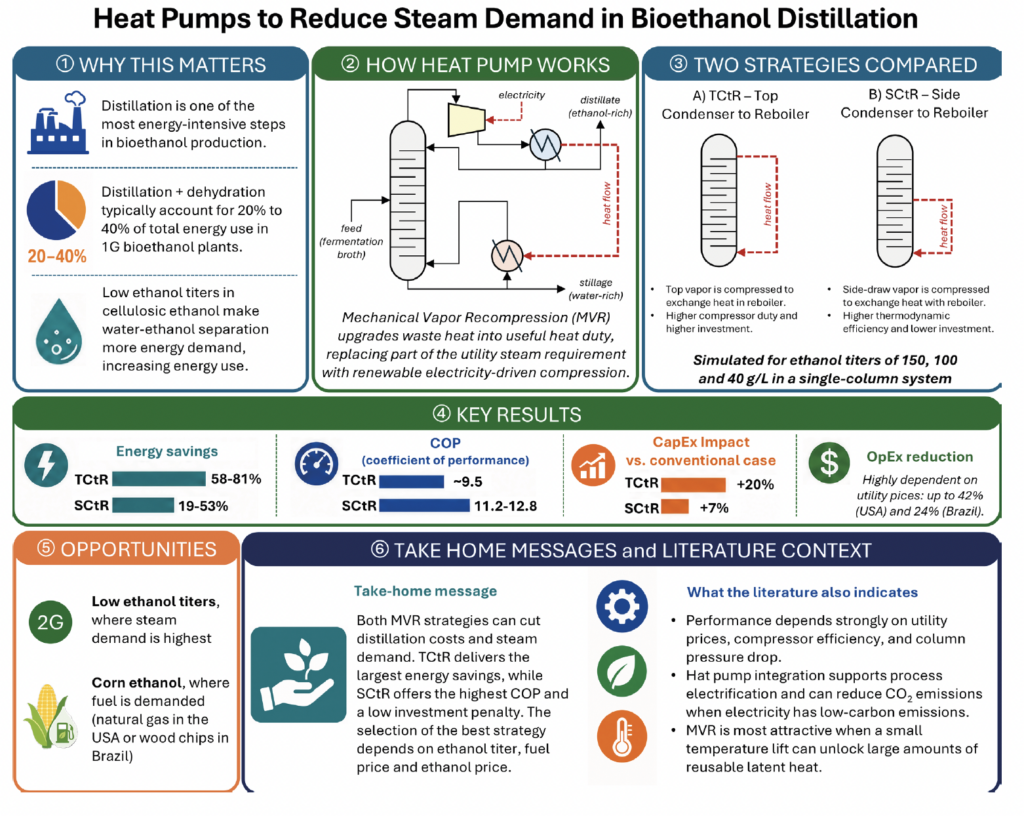
Heat Pumps to Reduce Steam Demand in Bioethanol Distillation