
IEA Bioenergy Task 39 invites experts from industry, academia, government agencies, financial institutions, standardization bodies, infrastructure providers, OEMs, fuel producers, multilateral organizations, and civil society to contribute to the Industry Hearing on Biofuels for Decarbonization of Land Transport process.
Participants are invited to complete a structured questionnaire designed to capture perspectives on:
- near-term emissions mitigation,
- fuel-engine-infrastructure compatibility,
- scalability across different regional contexts,
- infrastructure and logistics,
- sustainability certification and regulatory harmonization,
- public policies and financing mechanisms,
- and alignment with long-term net-zero pathways.
The questionnaire takes approximately 25–35 minutes to complete and is primarily structured in a multiple-choice format to enable consistent analysis of responses.
All responses will be treated confidentially and analyzed in aggregate. Participants may choose whether they wish to be publicly acknowledged as contributors to the process.
Participate!
Questionnaire on Sustainable Fuels for Land Transport
Access the questionnaire:
The questionnaire results will directly contribute to:
- the Industry Hearing discussions,
- the White Paper,
- and the Statement to be discussed in the context of COP31.
Answer by June 30th!
Industry Hearing on BIOFUELS FOR DECARBONIZATION OF LAND TRANSPORT
Organized by
Technical Lead: IEA Bioenergy Task 39 – Biofuels for Decarbonization of Transport
In collaboration with SAE BRASIL and the Society of Bioenergy (SBE)
About the Industry Hearing
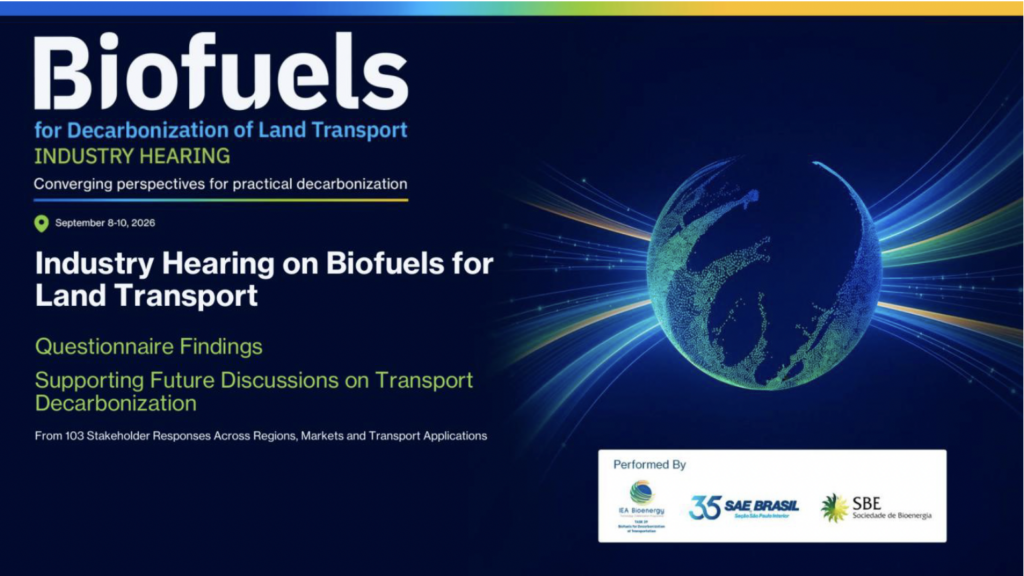
The “Industry Hearing on Biofuels for Decarbonization of Land Transport” is an international initiative coordinated by IEA Bioenergy Task 39 to gather technical, scientific, industrial, and policy input on practical pathways for transport decarbonization between 2026 and 2035.
The Hearing focuses on the role of sustainable fuels and end-use-oriented solutions for reducing greenhouse gas emissions from existing and future vehicle fleets and heavy-duty transport, particularly in sectors where rapid electrification remains challenging.
The initiative recognizes that more than 70% of the global 2030 vehicle fleet is already on the road, making immediate and scalable mitigation solutions essential. Sustainable biofuels — including ethanol, biodiesel, biomethane, renewable diesel, and advanced biofuels — can contribute measurable and near-term emissions reductions using existing engines and infrastructure.
The effort will generate two main outputs:
- A technical-policy White Paper (6–8 pages)
- A concise Statement on Sustainable Fuels for Land Transport to contribute to discussions leading to COP31
The work is aligned with:
- the UNFCCC Climate Action Agenda,
- the COP30–COP31 discussions on pathways for transitioning away from fossil fuels,
- and the implementation of sustainable fuels acceleration initiatives such as the Belém 4x Pledge.
Hearing Themes
Theme 1
— Fuel–Engine Compatibility, OEM Roadmaps, and Emissions Mitigation
- Compatibility of renewable fuels with current and future engine platforms
- Emissions mitigation potential across different technologies and fuels
- Hybridization and electrification convergence strategies
- Deployment pathways for light-duty, heavy-duty, and agricultural fleets
Theme 2
— Infrastructure, Logistics, and Market Uptake
- Infrastructure requirements for scaling sustainable fuels
- Distribution and refueling networks
- Regional opportunities and barriers
- Strategies for accelerating climate impact and market deployment
Theme 3
— Standards, Specifications, Certification, and International Convergence
- Harmonization of standards and specifications
- Sustainability certification systems
- Measurement, reporting, and verification (MRV)
- International regulatory convergence
Theme 4
— Public Policies, Business Models, and Financing
- Climate finance and investment frameworks
- Policies to accelerate deployment
- Public-private partnerships
- Business models for fleet transition and infrastructure expansion
Physical Meeting: September 8–10, 2026
In preparation, more info soon!
Venue
Instituto Agronômico de Campinas (IAC)
São Paulo State, Brazil
Format
- Day 1 — Open Workshop
- Day 2 — Technical Study Tour
- Day 3 — Closed Industry Hearing
The event will bring together experts from multiple sectors to discuss practical, scalable, and internationally relevant pathways for transport decarbonization.
International Advisory Committee
- Agustin Torroba (Inter-American Institute for Cooperation on Agriculture – IICA)
- Anders Röj (Consultant, Sweden)
- Andrea Sonnleitner (BEST, Austria)
- Andre Ferrarese (Tupy, Brazil)
- Atul Mulay (Praj Industries, India)
- Bharadwaj Kummamuru (World Bioenergy Association)
- Camilo Adas (SAE BRASIL)
- David Chiaramonti (Biofuture Platform)
- Dina Bacovski (BEST, Austria)
- Duncan Akporiaye (SINTEF, Norway)
- Evandro Maggio (Toyota do Brasil)
- Franziska Mueller-Langer (DBFZ, Germany)
- Fuli Li (Chinese Academy of Sciences, China)
- Gilberto Martins de Almeida (ANFAVEA, Brazil)
- Igor Calvet (ANFAVEA, Brazil)
- José Eduardo Castro Luzzi (Instituto MBCBrasil, Brazil)
- Luiz Augusto Horta Nogueira (UNIFEI, Brazil)
- Monalisa Sampaio Carneiro (International Society of Sugarcane Technologists)
- Prakash Lakshmanan (Guangxi Academy of Agricultural Sciences, China)
- Roberto Braun (Toyota Foundation, Brazil)
- Santanu Gupta (Global Biofuels Alliance – GBA)
- Tomas Ekbom (AFRY, Sweden)
The International Advisory Committee brings together experts from industry, academia, international organizations, automotive sectors, sustainability certification, and policy institutions to ensure scientific rigor, technological relevance, and international representation.
Governance
Technical Committee
IEA Bioenergy Task 39 National Team Leaders
Organizing Committee
Society of Bioenergy (SBE) and SAE BRASIL
The Industry Hearing is designed to ensure scientific neutrality, methodological rigor, and broad international representation across sectors and regions.
About IEA Bioenergy Task 39
IEA Bioenergy Task 39 – Biofuels for Decarbonization of Transport
Task 39 is an international collaboration under the IEA Bioenergy Technology Collaboration Programme focused on sustainable biofuels for transport decarbonization.
The Task develops scientific, technical, and policy-oriented work on biofuels deployment, sustainability, certification, end-use technologies, and pathways for hard-to-decarbonize sectors.
Follow Updates
Follow Task 39 activities and updates on LinkedIn:
IEA Bioenergy Task 39 LinkedIn
Contact
For additional information regarding the Industry Hearing process, participation, or questionnaires, please contact: Arthur Menezes (arthur.menezes@usp.br)

